Every year, preventable industrial accidents claim lives—many during routine maintenance when machines shouldn’t be operating. A worker reaches into a jammed conveyor, bypasses a safety switch, and suddenly the system powers back on. The result? Severe injury or death. This isn’t a hypothetical scenario—it’s a real risk in facilities across manufacturing, processing, and energy sectors.
At the heart of preventing these tragedies is one non-negotiable practice: Lockout Tagout, commonly known as LOTO. More than a compliance checklist item, LOTO is a systematic safety procedure that ensures machines and equipment are isolated from all energy sources before servicing. When done correctly, it stops catastrophic incidents before they start.
Yet too many organizations treat LOTO as a box-ticking exercise—using tags without locks, skipping energy isolation, or allowing informal “quick fixes.” That mindset costs lives. This guide breaks down what LOTO truly requires, how to implement it effectively, and why cutting corners puts everything on the line.
What Is Lockout Tagout (LOTO)?
Lockout Tagout (LOTO) is a safety procedure used to ensure that dangerous machinery is properly shut off and cannot be restarted until maintenance or servicing is complete. It involves two key actions:
- Lockout: Physically securing an energy-isolating device (like a circuit breaker or valve) with a lock to prevent accidental energization.
- Tagout: Attaching a warning tag to the locked device, identifying who applied the lock, when, and why.
The goal is simple: zero unexpected startup. Whether dealing with electrical, hydraulic, pneumatic, chemical, or mechanical energy, LOTO ensures that no single mistake—no miscommunication—can trigger a deadly release of stored energy.
Under OSHA regulation 29 CFR 1910.147, employers are required to have a written LOTO program, train employees, and conduct annual inspections. But compliance isn’t just about avoiding fines—it’s about building a culture where safety is non-negotiable.
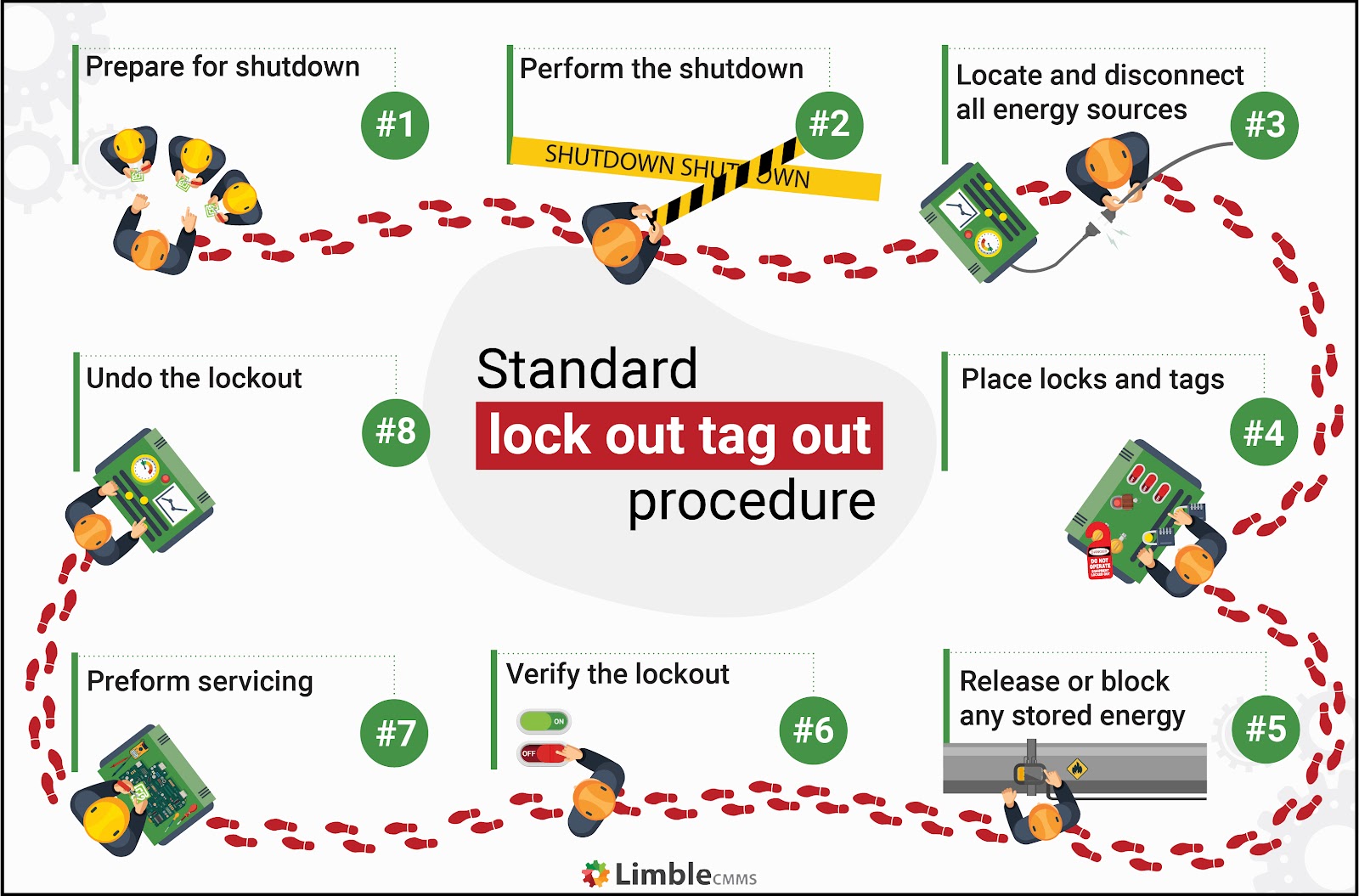
The 6-Step LOTO Procedure That Actually Works
Many facilities fail at LOTO not because they lack locks or tags, but because they skip or misapply core steps. A reliable LOTO process follows this sequence:
1. Prepare for Shutdown
Before touching any equipment, maintenance personnel must identify all energy sources (electrical, thermal, gravitational, etc.) and review the site-specific LOTO procedure. This is where a lack of documentation becomes dangerous—workers can’t isolate what they don’t know exists.
Example: A technician servicing a hydraulic press must account for both the main power disconnect and residual pressure in the hydraulic lines. Missing the latter risks sudden ram movement.
2. Notify Affected Personnel Everyone nearby must be informed that maintenance is about to begin. This includes operators, supervisors, and adjacent teams. Communication prevents someone from innocently restoring power thinking the machine is idle.
3. Shut Down the Equipment Use proper operating controls to turn off the machine. Never rely on emergency stops as the primary shutdown method—they aren’t designed to isolate energy.
4. Isolate Energy Sources
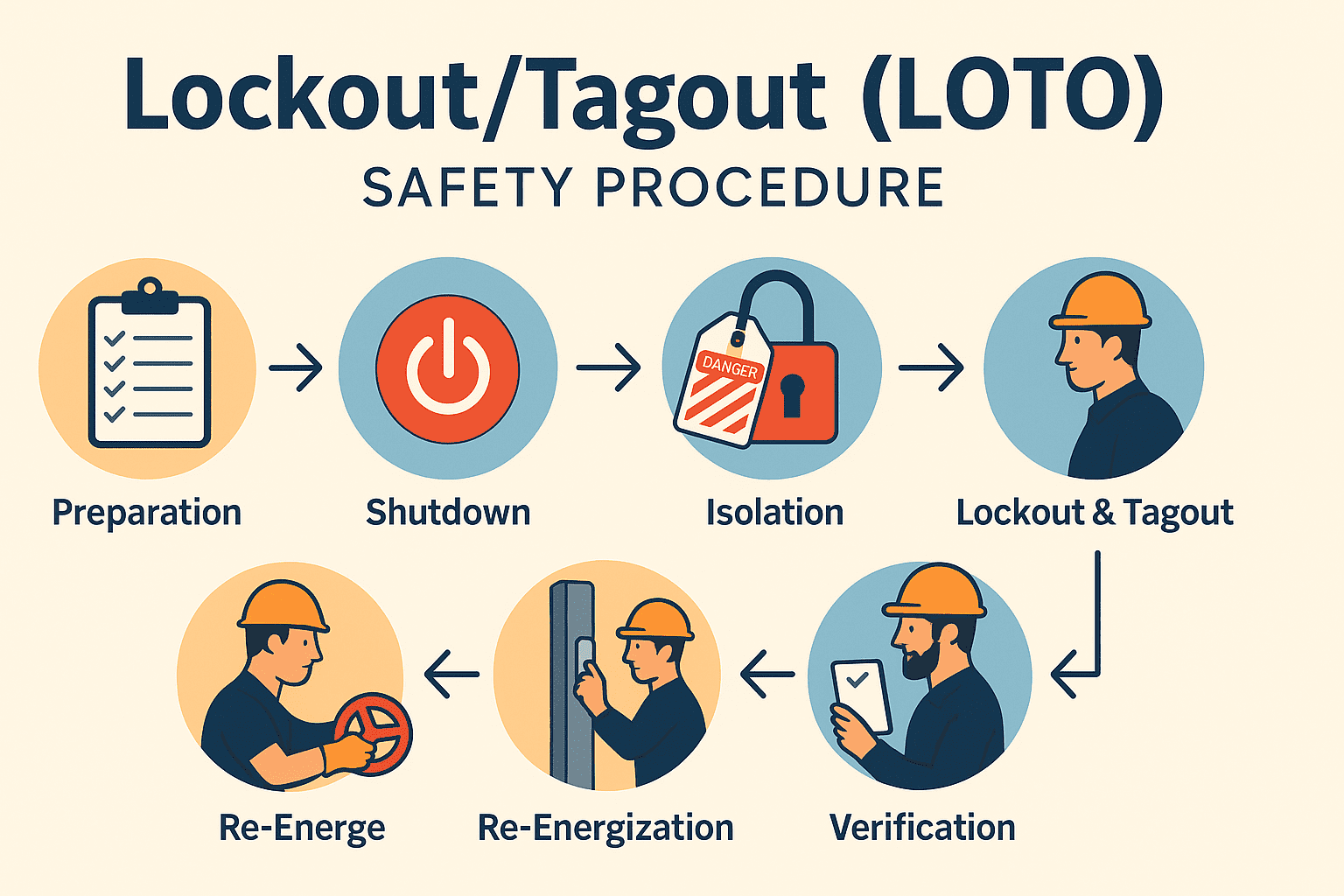
This is the core of lockout. Disconnect or block every energy source: - Flip circuit breakers and padlock them - Close and lock valves on fluid lines - Block moving parts held by gravity - Bleed off compressed air or hydraulic pressure
Each isolation point requires a unique lock—no group locks on one hasp unless each worker applies their own.
5. Apply Locks and Tags Each authorized employee places their personal lock and tag on every energy-isolating device. Tags must include: - Employee name - Date and time - Reason for lockout
Tags alone are not sufficient. OSHA allows tagout-only systems only if the tag provides equivalent protection to a lock—which is rare in high-risk environments.
6. Verify Zero Energy
Before starting work, test the machine: try to start it (it shouldn’t), check pressure gauges, use voltage testers. This "point of operation" verification is the final, non-negotiable safety check.
Skipping this step is one of the most common—and deadly—mistakes in the field.
Common LOTO Mistakes That Lead to Injuries
Even experienced teams make errors that undermine LOTO. Recognizing these patterns is the first step to eliminating them:
Using Tags Without Locks Tags are warnings, not barriers. A missing lock means energy can still be restored. In one OSHA case, a worker was killed when a colleague re-energized a conveyor because the tag had faded and wasn’t noticed.
Shared or Master Locks LOTO requires individual control. A single lock applied by a supervisor, or a master key accessible to others, violates the principle of personal accountability.
Incomplete Energy Isolation Machines often have multiple energy sources. A robotic arm might have electrical power, pneumatic actuators, and stored battery backup. Missing one source creates a hidden hazard.
Skipping Verification Assuming a machine is de-energized without testing it is a recipe for disaster. Use test instruments—don’t rely on indicators or assumptions.
Failing to Update Procedures Equipment changes over time. A LOTO procedure written five years ago may not reflect current configurations. Outdated documentation is worse than no documentation—it gives false confidence.
Who Is Responsible for LOTO? Roles and Requirements
LOTO isn’t just a maintenance team issue. It involves three key roles:
Authorized Employees These are trained personnel who perform servicing and apply LOTO devices. They must: - Understand energy types and isolation methods - Know how to use LOTO tools - Verify zero energy before starting work
Training must be refreshed annually, and hands-on re-certification is best practice.
Affected Employees These are operators who use the equipment but don’t service it. They must: - Recognize when LOTO is in place - Never attempt to remove a lock or tag - Know how to report unsafe conditions
Miscommunication between authorized and affected workers leads to 23% of LOTO-related incidents, according to NIOSH.
Employers Management holds ultimate responsibility. They must:
- Develop written energy control procedures
- Provide locks, tags, hasps, and test equipment
- Conduct annual audits of LOTO practices
- Enforce compliance without exception
A strong LOTO culture starts at the top. If leadership tolerates shortcuts, the system fails.
Real-World LOTO Applications Across Industries LOTO isn’t one-size-fits-all. Different environments demand tailored approaches.
Manufacturing On a production line, a jammed conveyor might require multiple isolation points: main motor disconnect, hydraulic feed, and control panel. Lockout stations with group lockout boxes allow teams to coordinate safely.
Energy and Utilities In substations, high-voltage lockout requires specialized equipment—insulated padlocks, voltage-rated tools, and strict clearance procedures. One misstep can cause arc flash.
Food Processing Wet environments complicate LOTO. Moisture-resistant locks and corrosion-proof tags are essential. Equipment like mixers or slicers often trap mechanical energy in springs or belts.
Construction Mobile equipment (cranes, lifts) introduces kinetic and gravitational energy. Blocking outriggers, lowering buckets, and securing hydraulic lines are all part of effective lockout.
Case Example: A paper mill avoided a serious injury when a mechanic followed full LOTO before clearing a roller jam. The team discovered residual pressure in a steam line—had they skipped verification, scalding steam could have released during servicing.
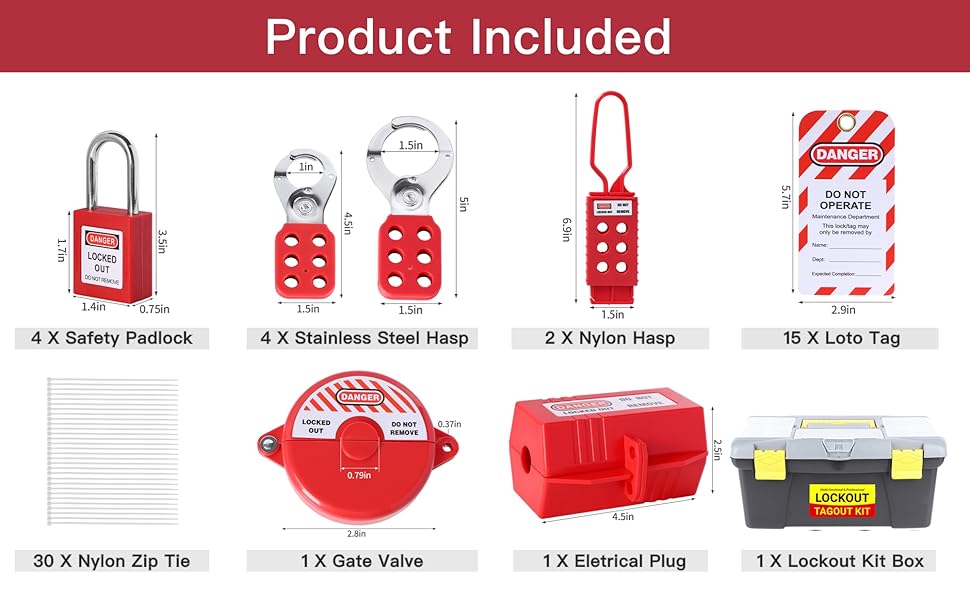
The Tools That Make LOTO Reliable
Effective LOTO depends on the right equipment. Here are five essential tools every facility should have:
| Tool | Purpose | Best Use Case |
|---|---|---|
| Personal Locks | Individual control of energy isolation | Each worker applies their own padlock |
| Lockout Hasps | Allow multiple locks on a single point | Group maintenance tasks |
| Valve Lockouts | Prevent accidental opening of fluid lines | Pipes, gas lines, hydraulic systems |
| Circuit Breaker Locks | Secure electrical disconnects | Control panels, motor starters |
| Tagout Devices | Communicate lock status and ownership | Always used with locks, never alone |
Investing in durable, standardized LOTO tools reduces confusion and increases compliance. Color-coding locks by department or energy type can further streamline the process.
Why Compliance Isn’t Enough—Building a LOTO Culture
OSHA fines for LOTO violations average over $15,000 per incident. But the real cost is human. Between 2011 and 2021, the Bureau of Labor Statistics recorded over 180 fatalities linked to failure in energy control.
Compliance is the floor, not the ceiling. To truly protect workers: - Conduct surprise LOTO audits - Empower employees to stop work if LOTO isn’t followed - Celebrate near-miss reporting - Use real incident data in training
One plant reduced LOTO violations by 76% in 18 months simply by requiring supervisors to perform weekly walkthroughs with maintenance teams—no corrections, just observation and dialogue.
Final Checklist: Is Your LOTO Program Effective?
Before any maintenance begins, ask: - ✅ Is there a written, up-to-date LOTO procedure for this equipment? - ✅ Have all energy sources been identified and isolated? - ✅ Did each worker apply their own lock and tag? - ✅ Was zero energy verified through testing? - ✅ Are affected employees aware of the lockout? - ✅ Has the procedure been audited within the last 12 months?
If any answer is “no,” the job should not proceed.
LOTO isn’t complicated—but it is unforgiving. It demands discipline, clarity, and a relentless focus on detail. No machine is worth a life. Implement LOTO not because OSHA says so, but because your team deserves to go home safe every day. Start today: review one procedure, train one employee, inspect one lockbox. Small actions build unbreakable safety cultures.
Frequently Asked Questions
What does LOTO stand for? LOTO stands for Lockout Tagout, a safety procedure to control hazardous energy during equipment maintenance.
Who needs LOTO training? Authorized employees (those performing servicing) and affected employees (those operating equipment) both require training.
Can tagout be used without lockout? Only in limited cases where a tag provides full protection—but OSHA strongly prefers lockout as the primary method.
How often should LOTO procedures be reviewed? Written procedures must be inspected annually, and whenever equipment or processes change.
What is the most common LOTO violation? Failure to verify zero energy before starting work is one of the most frequent and dangerous mistakes.
Are LOTO locks standardized? While not universally standardized, most facilities use durable, keyed-alike or keyed-different padlocks with employee identification.
Can multiple people use the same lock? No. Each authorized employee must apply their own personal lock during group maintenance.
FAQ
What should you look for in Lockout Tagout LOTO: What It Is and Why It Saves Lives? Focus on relevance, practical value, and how well the solution matches real user intent.
Is Lockout Tagout LOTO: What It Is and Why It Saves Lives suitable for beginners? That depends on the workflow, but a clear step-by-step approach usually makes it easier to start.
How do you compare options around Lockout Tagout LOTO: What It Is and Why It Saves Lives? Compare features, trust signals, limitations, pricing, and ease of implementation.
What mistakes should you avoid? Avoid generic choices, weak validation, and decisions based only on marketing claims.
What is the next best step? Shortlist the most relevant options, validate them quickly, and refine from real-world results.